


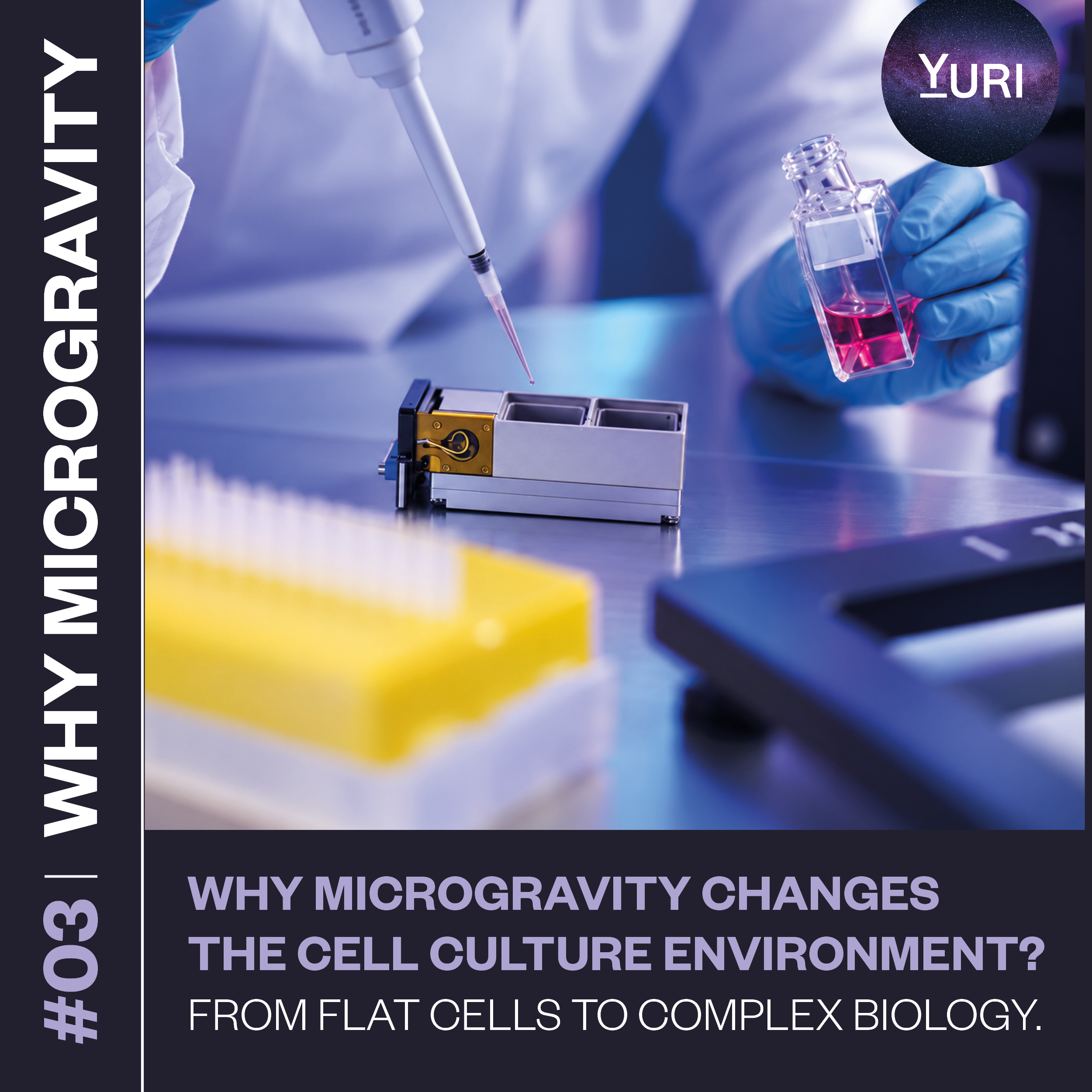
🌍 WHY MICROGRAVITY #3
From 2D to 3D: Why Microgravity Changes the Cell Culture Environment.
FROM FLAT CELLS TO COMPLEX BIOLOGY.
A lot of biological research still starts with cells growing on a flat surface.
But the human body is not flat.
Cells in our tissues interact with other cells and their surrounding extracellular environment in three dimensions.
This is one reason 3D cell models have become so important.
Microgravity introduces another interesting dimension.
With reduced gravity-driven sedimentation and buoyancy, altered convection and changes in mechanical loading, cells experience a very different physical environment.
Under the right experimental conditions, this can influence how cells interact, aggregate and organize and can support the formation and study of three-dimensional cellular structures.
And that matters because 3D models can reproduce certain aspects of cell-cell interactions, extracellular matrix interactions and tissue architecture that are difficult to capture in conventional 2D monolayer cultures.
Microgravity therefore offers researchers another environment in which to investigate how complex cellular structures form and behave.
Microgravity is not replacing terrestrial cell culture.
It gives researchers another environment in which to ask better questions.
And turning those questions into real experiments requires the right biological and technical infrastructure.
At Yuri, our ScienceShells provide modular bioreactor solutions for life-science research, while our Science as a Service approach supports researchers from study design and experiment development through mission integration, in-orbit operations and analysis together with qualified scientific partners where required.
Because accessing microgravity should not mean having to become a spaceflight expert first.
💡Next:
Organoids and why microgravity is becoming an increasingly interesting research environment for them.
#WhyMicrogravity #3DCellCulture #Organoids #CellBiology #SpaceBiotech #Microgravity #Biotechnology