


🌍 WHY MICROGRAVITY #02
Why Do Cells Behave Differently in Microgravity?
SAME CELLS. DIFFERENT ENVIRONMENT.
A cell may be microscopic.
But it is constantly responding to the physical environment around it.
On Earth, gravity contributes to sedimentation, fluid behavior and mechanical forces within the cellular environment.
In microgravity, those conditions change.
Researchers have observed changes in areas such as:
→ cell morphology
→ cytoskeletal organization
→ gene expression
→ cell signaling
→ proliferation and differentiation
→ cell-to-cell interaction
And that is exactly what makes microgravity scientifically valuable.
By changing the physical environment, researchers can observe biological responses that may be difficult to reproduce or recognize under conventional Earth conditions.
Microgravity therefore becomes more than a destination.
It becomes an experimental variable.
And this is where the right research hardware becomes essential.
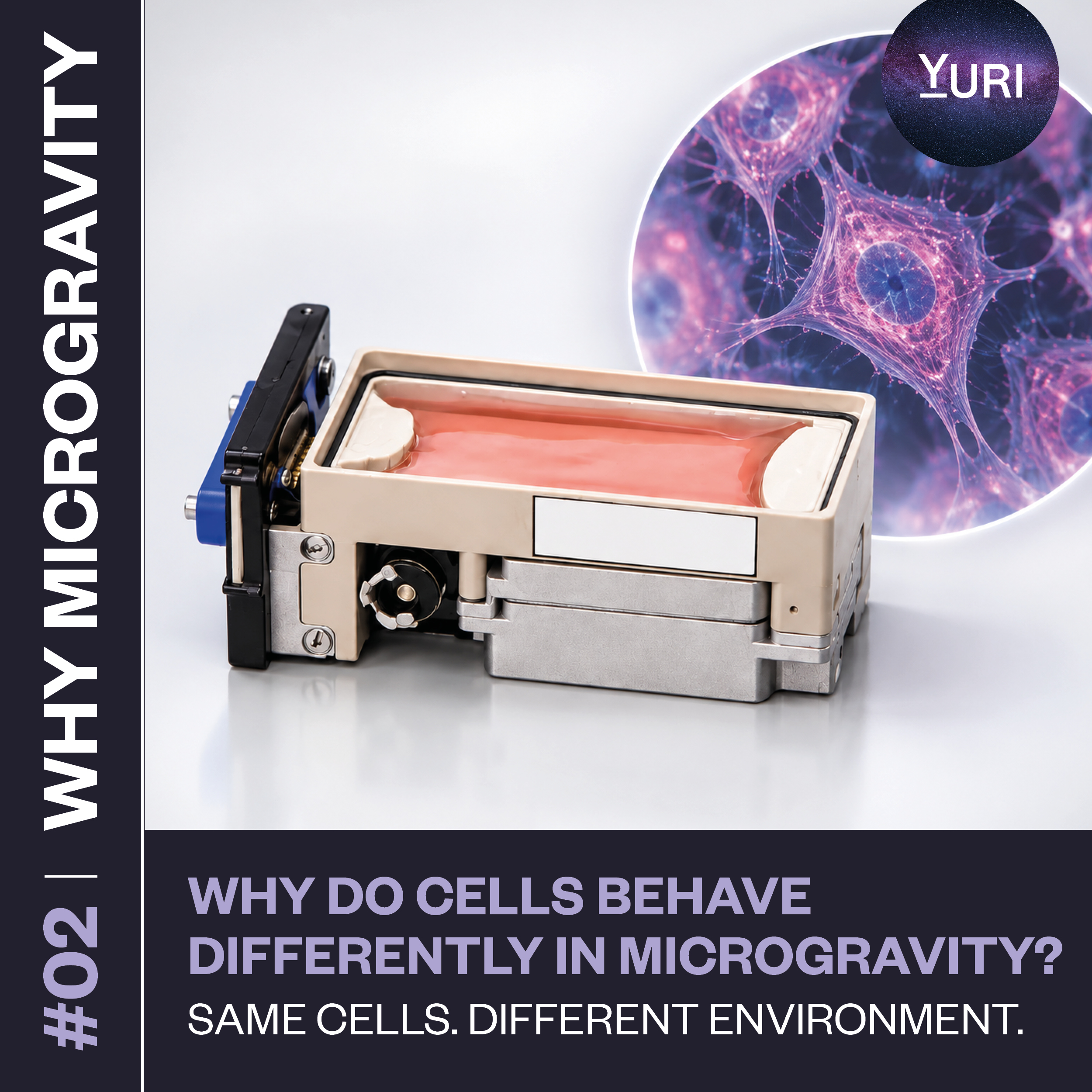
Yuri’s Type-IV ScienceShell is designed for active cell culture in microgravity, providing a controlled environment with automated nutrient exchange and sample fixation for biological experiments in orbit. The platform has already supported research with a wide range of cell types and is compatible with Yuri’s ScienceTaxi platforms.
Because understanding how cells respond to microgravity requires more than getting them to space.
It requires keeping their environment controlled while gravity is the variable that changes.
💡Next in our series:
What happens when cells are no longer forced to grow the way they usually do on Earth? How Microgravity Changes Cell Culture.
#WhyMicrogravity #CellBiology #ScienceShell #Microgravity #SpaceBiotech