


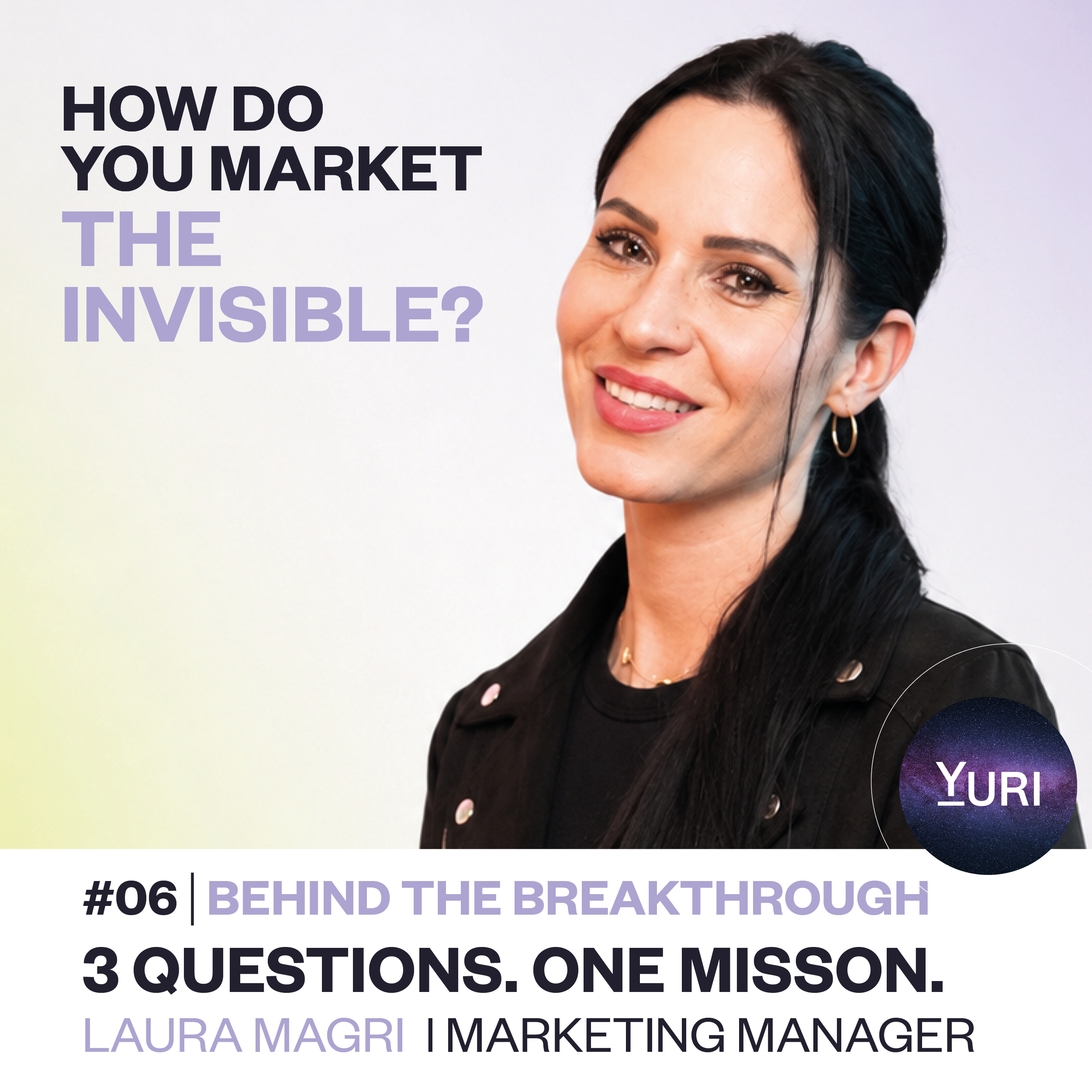
#5 Laura Magri - Marketing Manager
BEHIND THE BREAKTHROUGH
3 questions. One perspective. Zero gravity.
Great science doesn't automatically make a great story
After almost four years at Yuri, she's experienced firsthand how a space biotech startup grows, evolves and finds its voice.
Her challenge? Making complex science understandable, relevant and impossible to ignore, without compromising scientific credibility.
💬 01 | What's your secret to making complex space technology relevant to people who aren't space experts?
I always start with one question: Why should anyone care?
People don't become interested in technology simply because it's impressive. They become interested when they understand what it could mean for them.
That's why I prefer to start with the problem, not the product.
What are researchers trying to understand? Where do existing approaches reach their limits? And could microgravity offer a different perspective?
Once that connection is clear, the technology becomes relevant.
For me, great marketing isn't about making complex science sound simple. It's about making its value impossible to miss.
💬02 | What's the biggest misconception about marketing space biotech?
That the word "space" is enough to get people's attention.
Of course, space is fascinating. Rockets, astronauts and zero gravity create excitement almost instantly.
But excitement isn't the same as relevance.
A pharmaceutical researcher doesn't necessarily need another exciting space story. They need to understand whether a different research environment could help answer a scientific question.
That's the challenge I love: turning initial curiosity into genuine interest.
Because at the end of the day, we're not trying to sell the excitement of space.
We're showing why space could matter to science on Earth.
💬03 | After almost four years at Yuri, what still makes you think: "Wow, we can actually do that?"
Definitely 3D bioprinting in microgravity.
The idea that we can develop technology capable of printing and cultivating biological structures in orbit is incredible.
And what's even more fascinating is the research behind it: investigating how cells behave, organize and interact under different gravitational conditions.
With technologies like ScienceTaxi BioForge, we're working toward enabling exactly these kinds of experiments.
For me, that's where space biotech becomes truly exciting.
When you realize that a laboratory in orbit could help us explore questions about life here on Earth.
#BehindTheBreakthrough #MeetTheTeam #SpaceBiotech #MicrogravityResearch #ScienceCommunication #LifeSciences #TeamYuri